Modified Bitumen Roofing in Gilbert, AZ
Modified bitumen is a proven system that's been protecting commercial buildings for over 40 years. The granulated surface handles Arizona UV and the polymer-modified base stays flexible even when temps swing hard.
Modified Bitumen Roofing in Gilbert, AZ
Modified bitumen is a multi-ply roofing system that bridges traditional built-up roofing (BUR) and modern single-ply membranes. It's been in commercial use since the 1970s and remains a top choice for many building types — particularly multi-story buildings, buildings with extensive rooftop equipment, and owners who want the proven redundancy of a multi-ply system.
SBS vs APP Modified Bitumen
SBS (Styrene-Butadiene-Styrene)
SBS modifier gives the bitumen a rubber-like elasticity. SBS membranes remain flexible in cold temperatures, making them the choice for climates with cold winters. In Arizona, SBS performs well — the elasticity allows the membrane to accommodate thermal movement without cracking. SBS systems can be torch-applied, cold-applied with adhesive, or hot-mopped.
APP (Atactic Polypropylene)
APP modifier gives the bitumen a plastic-like quality with excellent UV and heat resistance. APP membranes are stiffer in cold weather but perform exceptionally well in hot climates — Arizona is actually ideal APP territory. APP is almost always torch-applied, which produces a continuous, fully-bonded assembly with no adhesive seams to fail.
Installation Methods
Torch-Applied
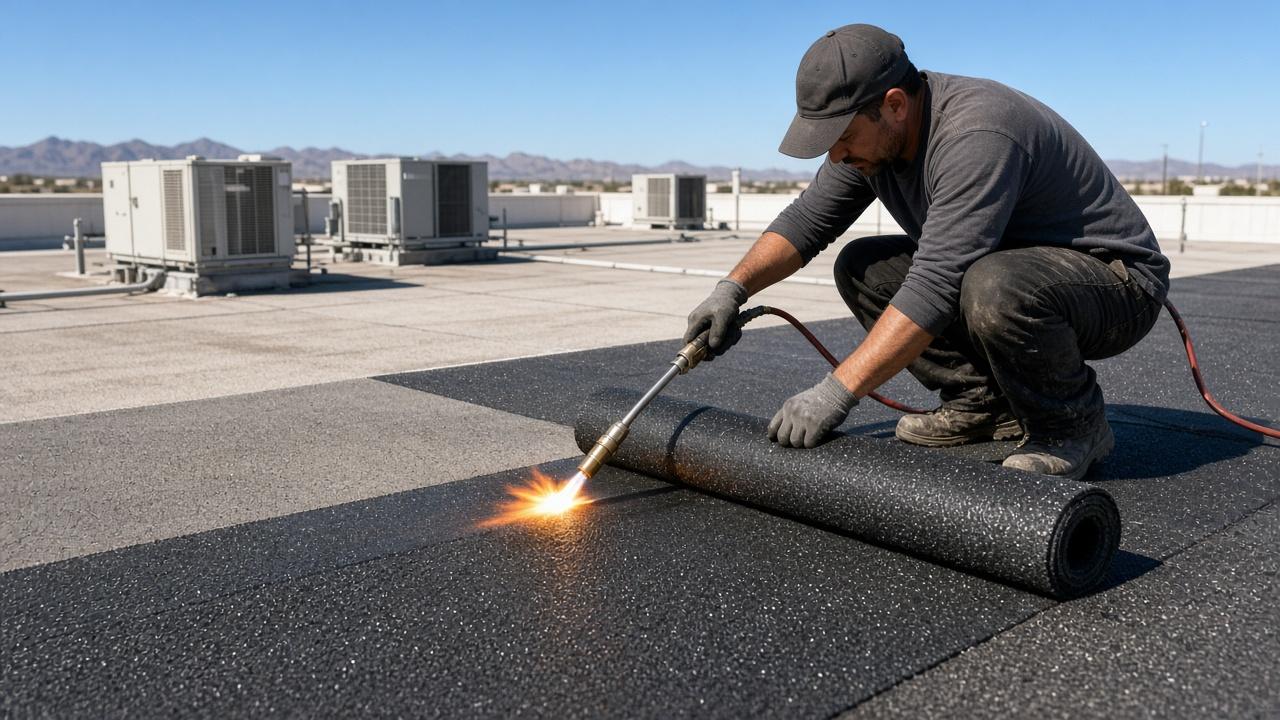
A propane torch heats the underside of the membrane roll as it's being unrolled, melting the factory-applied bitumen into the substrate or previous ply. Done correctly, torch application creates a fully bonded, monolithic waterproofing layer. It requires skilled applicators — too much heat damages the membrane, too little creates an incomplete bond.
Cold-Process
Cold-applied systems use a bituminous adhesive rather than heat. They work on structures where open flame is restricted, in occupied buildings with fire suppression concerns, or over substrates that can't handle heat. Cold-process systems require more cure time but eliminate the fire risk of torch work.
Granulated Cap Sheet
Modified bitumen systems almost always terminate with a mineral-surfaced cap sheet — a top ply embedded with ceramic or mineral granules. The granules protect the bitumen from UV degradation (bitumen's primary enemy), add impact resistance, and provide the finished appearance of the roof. White or light-grey granules improve solar reflectance — an important consideration in Arizona.
Frequently Asked Questions
How long does modified bitumen roofing last?
A properly installed two-ply modified bitumen system in Arizona typically lasts 15–20 years. Three-ply systems or those with additional insulation often reach 25 years. The granulated cap sheet protects the bitumen from UV and significantly extends service life.
Can modified bitumen be repaired?
Yes, mod bit is very repair-friendly. Torch-applied patches bond well to existing membrane. Cold-applied patches can be used on occupied buildings. Most membrane failures can be repaired without replacing the entire system.
Is torch-applied roofing safe?
Yes, when performed by trained installers following NRCA guidelines. We use fire watches, have fire extinguishers on hand, and conduct post-work inspections. Torch work on occupied buildings is coordinated with the building owner and fire suppression systems.
Related Services
Built-Up Roofing (BUR)
Built-up roofing has been trusted on commercial buildings since the 1800s. Multiple redundant plies of felt and bitumen create a robust membrane that holds up well in Arizona's demanding climate.
Flat Roof Repair
Flat roofs take a beating in Arizona — heat cycles, UV, and monsoon rains all push them to the limit. We find the problem fast and fix it right.
Commercial Roof Replacement
When repairs no longer make financial sense, a full replacement is the right call. We handle the entire process — permits, tear-off, deck repair, new membrane — with minimal disruption to your operations.
Need Mod Bit Roofing in Gilbert?
800+ commercial roofing projects completed across the East Valley. Get your free estimate today.