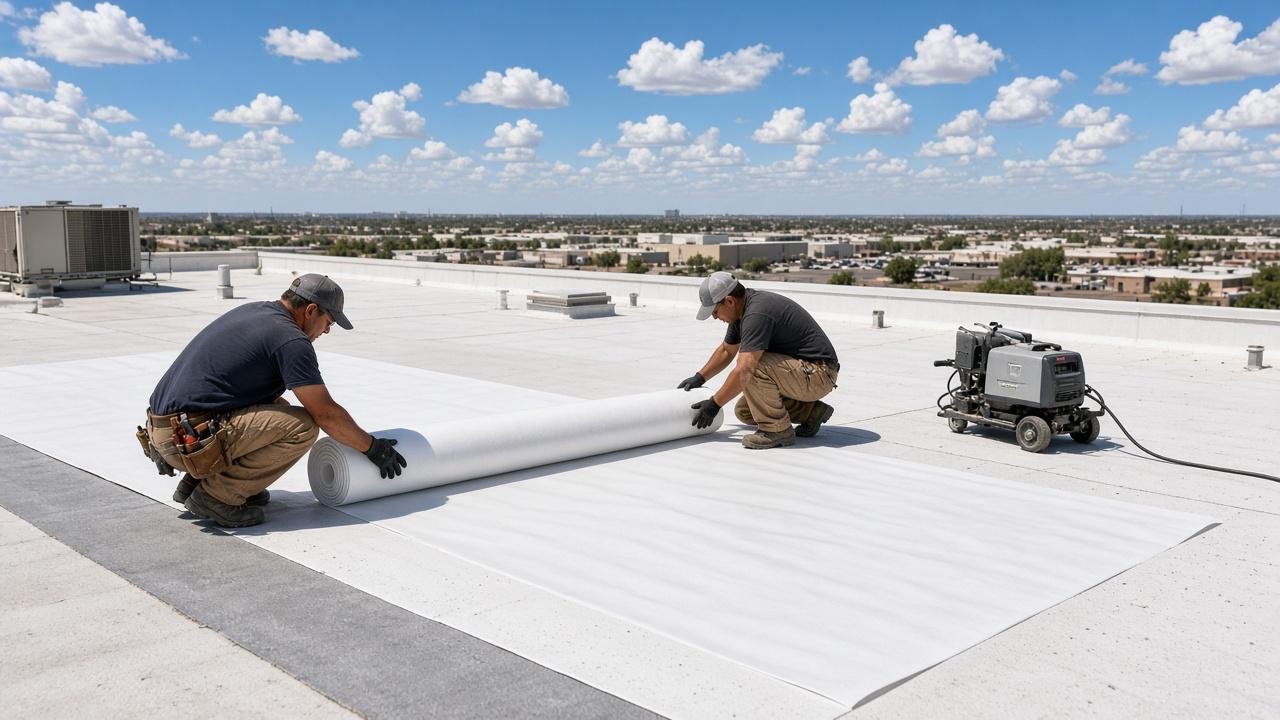
TPO Roofing Installation & Repair in Gilbert, AZ
TPO is one of the most popular commercial roofing systems in the Valley for good reason — it reflects heat, welds tight, and holds up against UV better than most options.
TPO Roofing in Gilbert, AZ — Why It's the Valley's Top Choice
Thermoplastic Polyolefin (TPO) is the most installed commercial roofing membrane in the United States, and it's especially well-suited to Arizona's climate. White TPO membranes reflect a significant portion of solar radiation rather than absorbing it — an important advantage when your roof surface would otherwise reach 170°F on a summer afternoon. That reflectivity translates directly into lower cooling costs for the building below.
TPO is a single-ply thermoplastic membrane, meaning it can be heat-welded at seams. Hot-air welding creates a bond that's stronger than the membrane itself — when a seam is properly welded and probed, it won't open under normal conditions. That's a significant advantage over adhered seam systems that rely on contact cement bonding.
TPO System Components and Installation
Membrane Thickness
TPO membranes come in three common thicknesses: 45-mil, 60-mil, and 80-mil. For most commercial applications in Arizona, 60-mil is the standard starting point. High-traffic roofs, roofs with lots of penetrations, or roofs with demanding warranty requirements typically get 80-mil. Thicker membranes resist puncture better and carry longer warranty terms from manufacturers.
Attachment Methods
TPO can be mechanically attached, fully adhered, or ballasted. In Arizona, fully adhered systems are common on lower-slope roofs where aesthetics matter or where the substrate is irregular. Mechanically attached systems use fastener plates through the insulation into the deck — faster to install and easier to inspect. Ballasted systems (weighted by river rock) are rarely spec'd in Arizona because of the added dead load on roofs that weren't originally designed for it.
Insulation
Most commercial TPO re-roofs include new polyisocyanurate (polyiso) insulation above the existing deck or over the existing system. In Arizona, proper insulation is particularly important — not just for R-value but for thermal bridging at fasteners. We typically install two layers of offset polyiso under fully adhered systems to eliminate thermal bridges.
Manufacturer Warranties
Major TPO manufacturers — Firestone, GAF, Carlisle, Versico — offer no-dollar- limit (NDL) warranties on installed systems ranging from 10 to 30 years depending on membrane thickness, insulation R-value, and contractor certification. As a manufacturer-certified installer, we can offer these warranties on qualifying projects. The warranty covers both material and labour — not just the membrane.
TPO in Arizona's Climate
The main concern with TPO in extreme-heat climates used to be heat-ageing — older TPO formulations would harden and crack over time. Modern third-generation TPO formulations have significantly better heat-age resistance. White TPO membranes in Arizona typically maintain their flexibility and waterproofing integrity well past 20 years when properly installed and maintained.
Monsoon season is the other test. TPO seams welded to manufacturer spec (minimum 1.5-inch probe-tested weld at every seam) perform well under heavy rain loads. The critical detail is termination — where the membrane meets the parapet, where it goes around HVAC curbs, and where penetrations pierce the surface. These areas need proper flashing membrane work, not just caulk.
Frequently Asked Questions
How long does TPO roofing last in Arizona?
A properly installed 60-mil TPO system with adequate insulation typically performs for 20–25 years in Arizona. Thicker 80-mil systems and those with heavier insulation assemblies often exceed 25 years with routine maintenance.
Does TPO roofing reduce cooling costs?
Yes. White TPO reflects roughly 80% of solar radiation compared to dark BUR or EPDM surfaces that absorb most of it. Building owners in Arizona commonly report meaningful cooling cost reductions after switching from dark to white membrane systems.
What is the difference between TPO and PVC?
Both are thermoplastic single-ply membranes that can be heat-welded. PVC has better chemical resistance — important for buildings with grease or chemical exhaust. TPO is generally more cost-effective and has better heat-age resistance. For most standard commercial applications TPO is the better value.
Related Services
Roof Coating & Restoration
A quality coating system can add 10–15 years to a commercial roof that still has structural integrity. It's often one-third the cost of a full replacement and keeps tons of material out of the landfill.
Commercial Roof Inspection
You can't manage what you can't see. A thorough roof inspection gives you a clear picture of what's happening up there — before a leak shows up on the inside.
Commercial Roof Replacement
When repairs no longer make financial sense, a full replacement is the right call. We handle the entire process — permits, tear-off, deck repair, new membrane — with minimal disruption to your operations.
Need TPO Roofing in Gilbert?
800+ commercial roofing projects completed across the East Valley. Get your free estimate today.